
UNDER 10
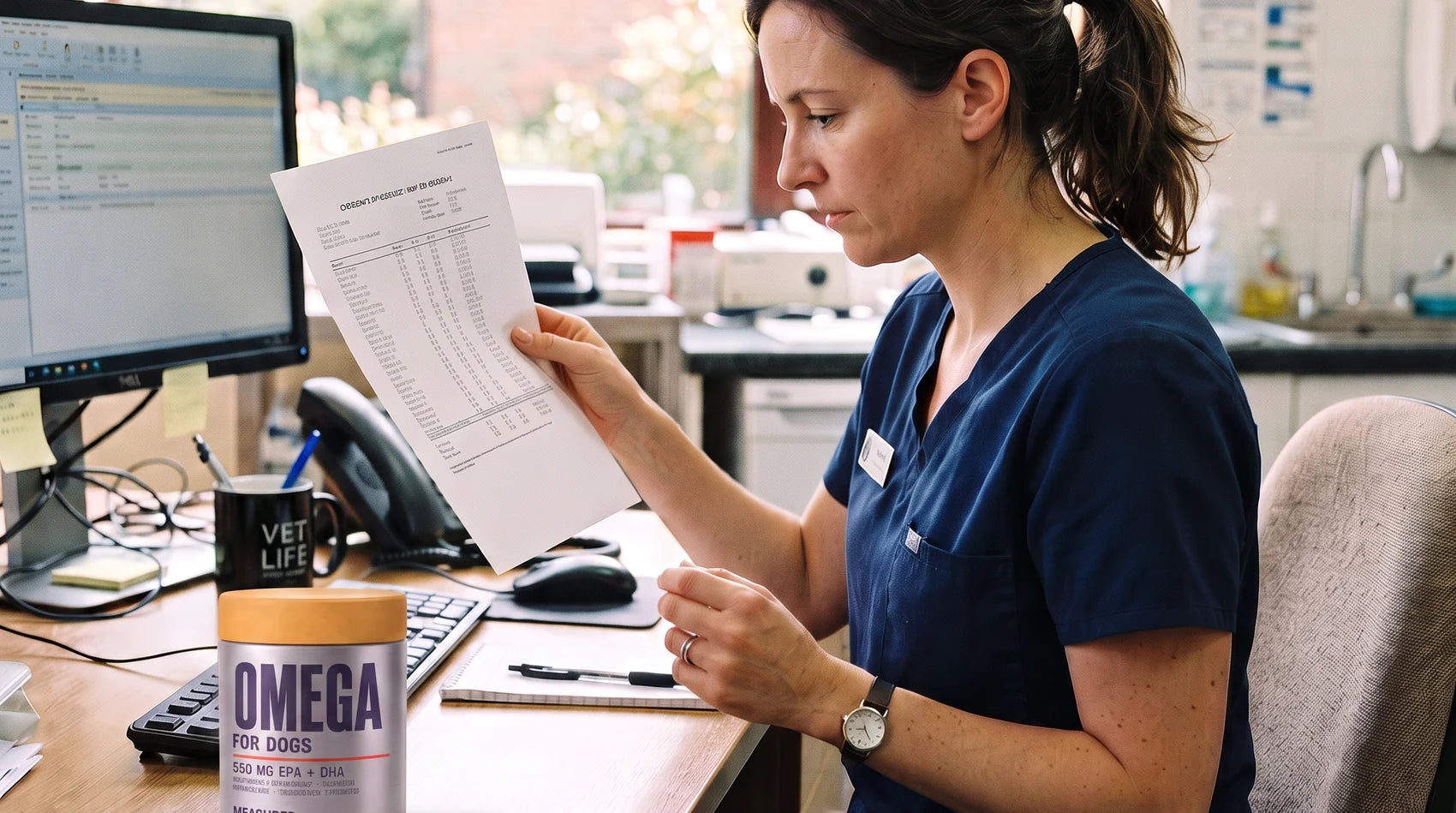
Veterinary-formulated skin and coat support, built on an oxidation number you can read.

The Measured Dog Mechanism

Week one you will not see anything. That is not the oil - that is how omega-3 works
Every fish oil on the shelf promises a shinier coat in days. It isn't true, and it's worth knowing why.
Measured Dog is built for the clock omega-3 actually runs on.
Omega-3 doesn't act on today's dinner. It has to be absorbed, carried, and built into the membrane of every cell in his body - and that part takes weeks. So two things happen on two very different clocks: one you can measure in his blood inside a week, and one you can see in how he moves three months later.
In his bloodstream, not yet in his coat
Get the fatty acids measurably into him.
This is the part nobody advertises, because it isn't visible. Fed daily, EPA and DHA are significantly raised in the membranes of his red blood cells within one week - measured in dogs, not assumed. It's also why dosing by eye from a bottle fails here: stop for three days and blood levels fall back to where they started. Nothing about his coat or his gait has changed yet. The material is simply in place.
The stage a force plate can see
Let the membranes fill, and it shows up in how he moves.
Membrane levels keep climbing long after that first week, and they don't reach steady state until somewhere between week 8 and week 16. That's why the honest number here is 90 days, not 10. In dogs with joint trouble fed omega-3 for 90 days, weight bearing on the worst limb improved measurably - and in dogs that started with a poor coat, coat condition scored better from day 60. Both are slow. Both are real.
“1,000 mg fish oil” is a container size, not a dose
Anyone can add a popular ingredient to a label. Very few brands tell you how much is actually inside.
At Measured Dog, every active ingredient is included at a precisely measured dose and disclosed on the label, never hidden inside proprietary blends. Because research isn't just about what works. It's about how much of each ingredient delivers noticeable results.
The amounts below represent the full daily serving for a 90 lbs dog. Smaller dogs receive proportionally adjusted servings based on body weight, ensuring every dog receives the right amount of each active ingredient.
The larger of the two omega-3s in this oil, and the one most of the canine research is built on. In a prospective, randomised, double-blinded, placebo-controlled trial in dogs with osteoarthritis, EPA and DHA improved the clinical signs the veterinarians were scoring - and the researchers went further and measured the EPA and DHA sitting in the dogs' red blood cell membranes. That second part is the one worth reading: it is evidence the fat got into the dog, not just into the bowl.
View clinical study ↗The structural one, and the one the skin and coat work is built on. In an eight-week open-label trial, dogs with atopic skin put on a diet built around EPA and DHA had their scratching scores fall by 44% and their redness scores by 48% - scored both by the veterinarian in the clinic and by the owner at home.
View clinical study ↗Not there for him. It is there for the oil - it slows the oxidation that turns a good fish oil into a bad one on the shelf. The peer-reviewed review of what can go wrong with fish-oil omega-3s in dogs and cats lists lipid peroxidation among the risks, and that is exactly why an antioxidant is dosed alongside the oil instead of being left out of it. Same job as the number at the top of this page.
View clinical study ↗What owners noticed first




Why this is a softgel and not a bottle of oil
A pump bottle of fish oil is open to air from the day you unscrew it. Air is the thing that oxidises fish oil - so every day that bottle sits in your fridge, the number this whole page is about gets worse.
A softgel is a sealed single dose.
The oil meets air at the moment your dog swallows it, and not before. Which is also why there is no oily bottle in the fridge, no smell on your hands, and no guessing at how big a squeeze is.
93% Acceptance Rate
None of this matters if he won't take it. Across 156 dogs tested over four months, 93% took the softgel without an argument - most of them treat it like a treat. There is no powder to hide in the bowl and no oil to argue about.
99% Crude Fat
Almost the entire capsule is the oil itself. There is no filler bulking it out, no starch, no water - which is why one softgel can carry a dose worth printing instead of a dose worth hiding.
Vet-Grade 33/22™ Concentration
"1,000 mg of fish oil" is a container size, not a dose. What matters is what is inside it: 330 mg EPA and 220 mg DHA, printed per capsule, so you can compare it to whatever is in your cupboard right now. Most bottles will not give you that number, and that is the answer.
Deep-Pur™ Omega Refining System
Fish oil goes rancid, you cannot smell it through a capsule, and a dog will eat it anyway. Deep-Pur is the refining step that strips heavy metals, PCBs and dioxins and takes the oil to a TOTOX below 10 - the combined measure of how far oxidation has already gone. Below 10 is what a human-grade supplier is held to. Nobody in the dog aisle prints it.
Compare what actually matters
Most fish oils for dogs look similar.
The real difference isn't what's written on the front of the label.
It's how the formula is built.
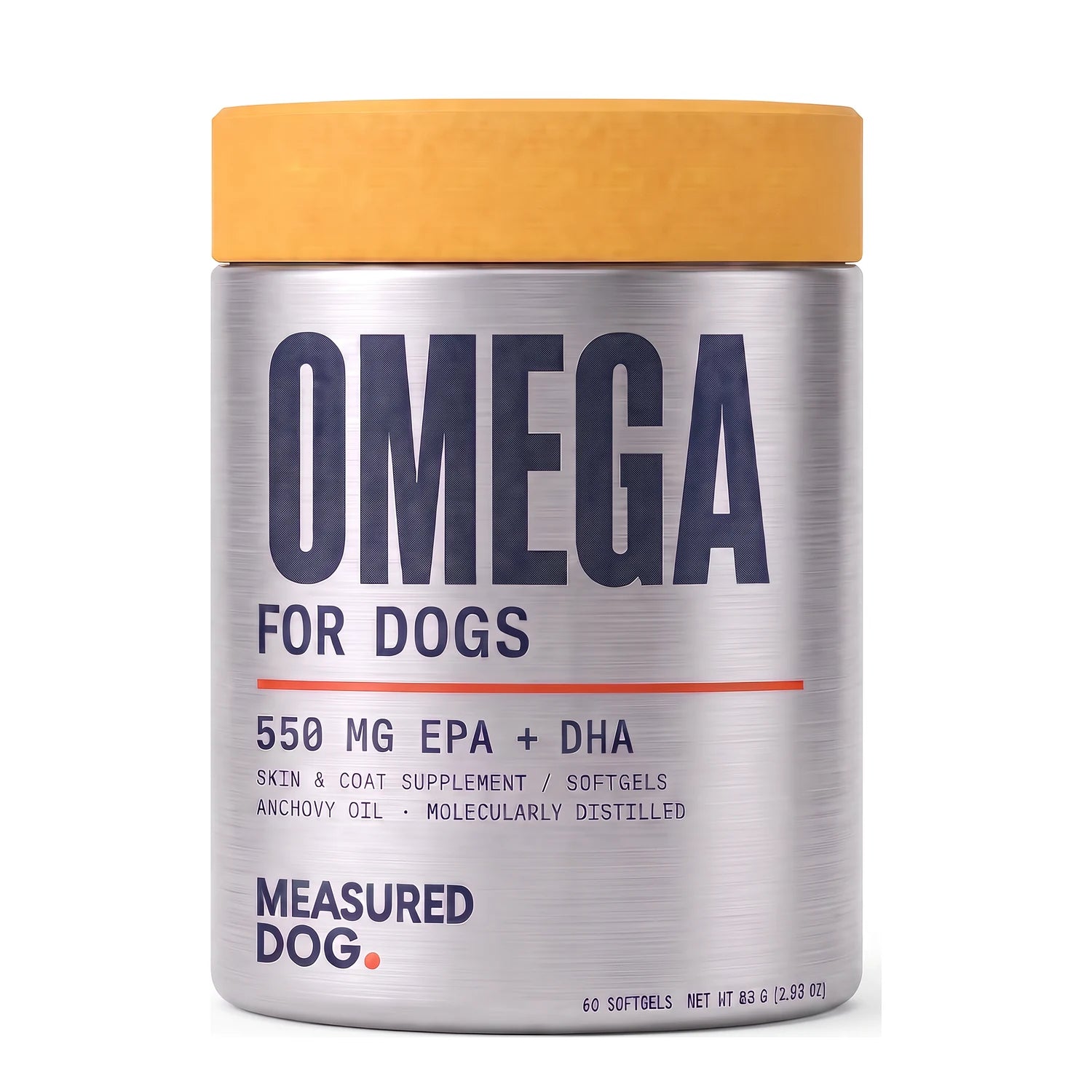
for dogs
Active-ingredient range calculated from published ingredient panels of US dog fish oil supplements, September 2026. Describes the category, not any named brand.
Measured Results™
Every claim we make should be measurable.
Coat and joints do not arrive together, and pretending otherwise is how a fish oil loses people in week three. This is the order things actually happen in.
Typical timelines on consistent daily use, not a guarantee. Results vary between dogs. Measured Dog is a nutritional supplement, not a veterinary medicinal product.
Why veterinarians recommend it

Small-animal veterinarian. Reviewed the EPA and DHA figures printed per softgel.
General practitioner with 12 years of experience. Reviewed the oxidation testing and the sourcing of the oil.

Specialist in veterinary nutrition. Reviewed the formula structure and the 90-day recommendation.